BOPP Film Shredding and Recycling
Efficient recycling solutions for post-industrial BOPP film waste with WEIMA shredders


When polypropylene film (PP) is stretched lengthwise and crosswise, stable BOPP film (biaxially oriented PP film) is created. This thermoplastic is one of the most widely used materials for flexible packaging worldwide. BOPP films impress with their high strength, transparency and very good barrier properties.
Whether classic transparent film, pearl white, metallized or micro- and macro-perforated variants - WEIMA offers high-performance shredding solutions for all types of BOPP film in order to efficiently recycle production waste and return it to the material cycle.
Customer applications: BOPP film shredding with WEIMA
Practical examples of successful shredding with WEIMA shredders


Want to tackle your waste problem?
Request a customized shredding solution now.
WEIMA portfolio for shredding BOPP film
The right machine for every material


Developed for flat materials such as films: The F-Rotor
The optimum coordination of rotor, knives and counter knives is crucial for the shredding result. The selection of the components suitable for the material requires a high degree of experience. The F-rotor, specially designed for films, is characterized by its controlled feeding behavior.
By the way: For particularly abrasive or dirty materials, we recommend wear protection made of Vautid.

WEIMA F-rotor
Inquire about a BOPP shredder today
Request a quote
Recycling of BOPP film
The most important facts at a glance


See for yourself.
Have your material tested free of charge in our test center.
Practical examples and references | BOPP film recycling with WEIMA
WEIMA shredders are synonymous with efficient plastics recycling worldwide including at
JINDAL Poly Films
Taghleef


Frequently Asked Questions about BOPP film shredding
Everything you need to know about safely and efficiently shredding BOPP film.
Is in-house recycling of our BOPP film waste worth it?
Yes, if your plant generates a steady stream of BOPP film waste, in-house recycling can significantly reduce disposal needs, lower virgin material consumption, and stabilize your material supply. Shredding converts loose film into consistent, flowable flakes that are ideal for regranulation and reintegration into production. This also reduces forklift traffic and storage volume because fluffy film becomes compact, manageable flakes.
Which types of BOPP films can your shredders handle?
WEIMA shredders can process transparent, pearl white, metallized, printed, and coated BOPP films as well as post-industrial waste such as edge trim, changeover waste, and off-spec rolls. The setups shown on this page work across a broad range of packaging films. Machines like the S7.20 lift-up model and the W5.22 are demonstrated at DiAxon and EcoFib, showing compatibility with all major BOPP film types. With the right cutter geometry and feeding method, the system can handle films of varying thickness, stiffness, and surface finish.
How does a WEIMA BOPP film recycling setup work from start to finish?
Film waste is fed into a single-shaft shredder such as the W5.22 or S5.20, where it is reduced to uniform flakes. The flakes are then conveyed to a downstream regranulation system, processed into pellets, and returned to your production line. Depending on your layout, the entire system can be configured around existing material flows and intralogistics.
We process light, slippery film. Will it wrap around the rotor?
No, WEIMA provides film-optimized rotors and controlled feeding systems that help prevent wrapping and bridging. BOPP films are strong, thin, and slick, which can cause issues in general-purpose shredders, but WEIMA’s film-ready designs address this directly. Options like the F-Rotor and tailored feed systems keep material engaged with the rotor and maintain stable throughput. Because film strength is defined by standards such as ASTM D882, a rotor geometry designed specifically for films makes a measurable difference in practice.
What does the shredded output look like, and is it ready for regranulation?
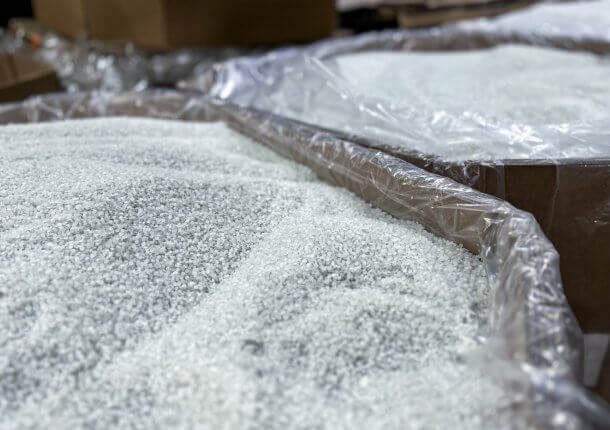
The shredded output consists of uniform, flowable flakes that are easy to convey, dose, and melt in an extruder. These flakes are directly suitable for regranulation. WEIMA showcases post-industrial film recycling where the W5.22 produces clean, consistent flakes that customers process back into film production. Reliable flake uniformity helps reduce material costs and keeps the process loop simple.
Can a WEIMA shredder be integrated into our existing production line?
Yes — WEIMA shredders are engineered for seamless in-line integration. The system can connect directly to conveyors and downstream recycling equipment, allowing material to move smoothly from production to shredding and then to regranulation. This reduces internal handling effort while turning bulky, hard-to-manage film waste into clean, compact flakes. The result is a streamlined intralogistics workflow and a more efficient recycling loop.
What maintenance should we plan for on a film shredder?
Routine maintenance includes knife checks, cleaning around the cutting chamber, and regular inspection of wear parts. WEIMA’s designs prioritize access, making daily service straightforward. Keeping knives sharp, removing buildup, and following scheduled inspections ensures consistent flake quality and dependable throughput. A simple preventive maintenance plan keeps uptime high and long-term performance stable.
What are you looking for?
Explore all WEIMA solutions

